Arabian Tahr and the Hajar Mountains: The UAE's Rugged Biodiversity Frontier
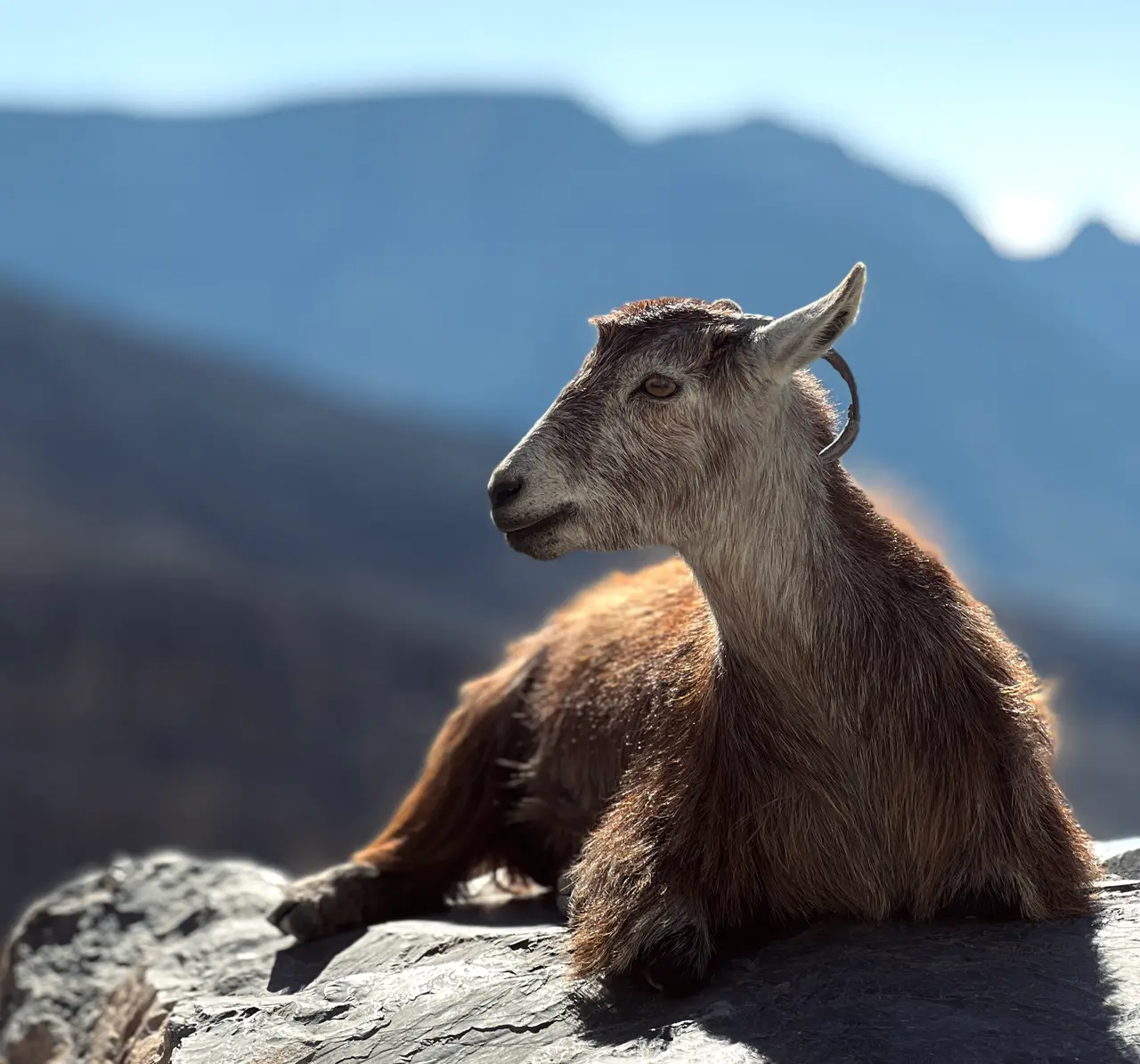
Most visitors to the UAE picture sand and coastline. Drive inland from the northern coast, though, and the land rises into the Hajar Mountains, a range of bare rock, deep wadis and small terraced villages that continues into northern Oman. The mountains hold a species that is found only in these ranges: the Arabian tahr, a wild goat that has adapted to some of the steepest ground in the region.
The Arabian Tahr
The Arabian tahr (Arabitragus jayakari) is built for broken, vertical terrain. Both males and females carry horns, and the animals move confidently on cliffs that would stop most livestock. They feed on grasses, leaves and shrubs, and shift between ledges and wadi bottoms as the seasons and the availability of water and forage change. The International Union for Conservation of Nature (IUCN) lists the species as Endangered, which means it faces a high risk of extinction in the wild.
Why Wadis Matter
The tahr's habitat is shaped by wadis, the seasonal watercourses that cut through the mountains. Most of the year they are dry, but after rain they can flow quickly and carry water and sediment down the valley. Along the wadi beds grow trees and shrubs that tolerate long dry spells, including ghaf and sidr (Ziziphus spina-christi). These plants hold soil in place, provide shade and food, and form green corridors that link small patches of habitat. Protecting that vegetation is as important for the wildlife as protecting the cliffs above it.
Pressures on the Mountain Habitat
Mountain habitats in the UAE face several pressures at once. Grazing by goats and other livestock can strip vegetation faster than it recovers, especially in the dry season. Roads, quarrying and construction break up the slopes and split the habitat into smaller pieces, which makes it harder for animals to move between feeding areas. Rainfall in the region is also highly variable. A run of dry years can reduce the plants the tahr depends on, and a sudden flood can wash out lower wadi vegetation. None of these pressures is unique to the mountains, but together they make degraded habitat slow to recover.
Restoration and Its Limits
Restoring a mountain habitat is different from restoring a mangrove stand or a planted desert area. The work usually centres on reducing grazing pressure, protecting wadi vegetation and limiting new disturbance, rather than planting large numbers of trees. Outcomes are also harder to measure. Vegetation cover can be surveyed and sightings can be recorded, but wild animals on steep ground are difficult to count precisely, and changes may take several seasons to show.
That difficulty matters for biodiversity credits. A claim that a project has improved a species or a habitat needs a documented baseline, a clear monitoring method and evidence that the outcome would not have happened without the project. For a mountain site, the baseline should record grazing and disturbance levels before work began, and the monitoring plan should say how change will be detected and who checks it. Where a project cannot show this, the claim is better described as a commitment than as a credit.
What to Ask Before Relying on a Claim
Ask which species or habitat the claim covers, what the baseline was, how monitoring is carried out, who verifies the results and how often, and whether the same land is being claimed for any other outcome. A project that can answer these questions in plain terms is far more useful to a buyer than one that leads with a headline number.
Frequently Asked Questions
Where can the Arabian tahr be found? In the Hajar Mountains of northern Oman and the northern UAE. It is not a species of the coastal plains or the sand deserts.
What is the conservation status of the Arabian tahr? The IUCN lists it as Endangered. Anyone who sees one should report it to the relevant environmental authority rather than approach or feed it.
Are mountain habitats relevant to carbon or biodiversity credits? They can be, but they are harder to measure than coastal sites. Any claim needs a clear baseline, a monitoring plan and independent verification.
Related: The Ghaf Tree: The UAE's National Tree and a Keystone of the Desert | The Arabian Oryx: From Extinction in the Wild to a UAE Desert Success Story