The Houbara Bustard: A Migratory Desert Bird and What Its Survival Asks of Conservation
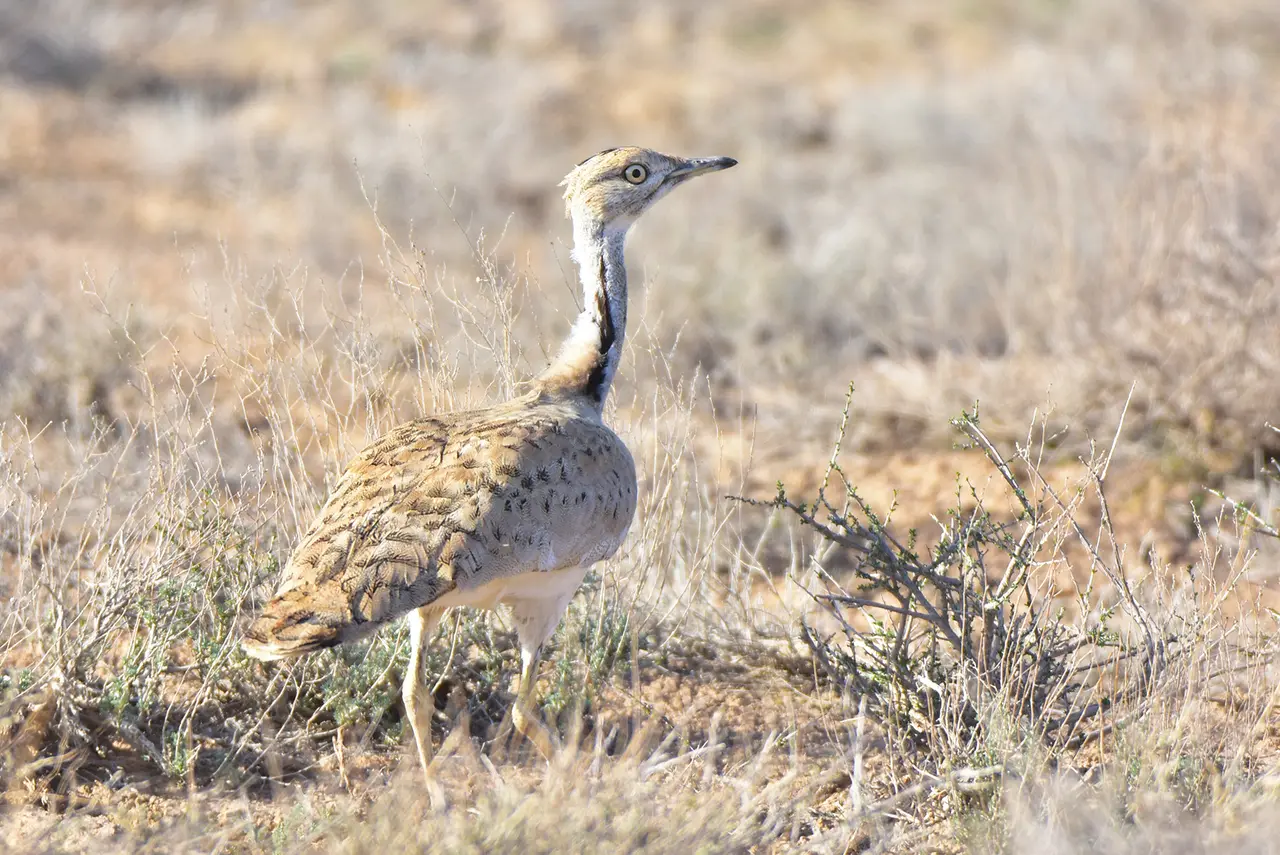
Few animals of the UAE desert are as hard to see as the houbara bustard. It is a ground-dwelling bird with sand-coloured plumage that disappears among gravel plains and low shrub, and much of its life is spent on journeys that cross national borders. That combination of camouflage and long-distance movement makes it a symbol of the desert and a difficult species to protect.
The Bird and Its Range
The houbara bustard (Chlamydotis macqueenii), often called the Asian houbara, breeds in the steppe and desert of Central Asia and spends the winter in the warmer deserts of Iran, Pakistan and the Arabian Peninsula. The UAE is therefore one stage on a route that spans several countries, and the health of the population depends on conditions far beyond the Emirates as well as within them. The International Union for Conservation of Nature (IUCN) lists the species as Vulnerable.
How It Lives in the Desert
Houbara favour open ground with scattered shrubs, gravel plains and sparse vegetation, where they can see a predator coming from a distance. They feed on insects, seeds, leaves and small animals, and they can manage with little free water. Their camouflage is their main defence. A bird that sits still beside a clump of shrubs can be hard to spot even at close range, and the same habit makes them vulnerable to disturbance, because a bird that stays put may not move away from a vehicle or a person until it is too close.
Pressures on the Population
Three pressures stand out. The first is habitat loss. Roads, fencing, urban expansion and farming convert open desert into land the bird no longer uses. The second is hunting. Houbara have long been prized as quarry in falconry, and the scale and regulation of that hunting has been a central question for governments across the species' range. The third is a set of pressures that are harder to see, including collisions with power lines and fences and changes in the rainfall that drives the insects and plants the birds rely on. Because the birds migrate, no single country controls all of these factors.
Breeding and Release Programmes
Captive breeding and release has become one of the main tools for supporting houbara numbers in the Gulf. Research centres in Abu Dhabi and elsewhere in the region have worked on breeding birds in captivity, studying their health and behaviour, and releasing them into protected or managed areas. Such programmes depend on careful planning. Birds must be fit enough to survive in the wild, released into habitat that can support them, and monitored afterwards, often with tracking devices, to learn whether they survive, breed and remain within the release area.
What This Means for Biodiversity Credits
A release programme shows clearly why buyers need to read a claim carefully. A project can usually report how many birds it released. It is much harder to show how many were alive a year later, how many bred, and whether the local population would have declined without the programme. A credible claim has to answer those questions, and they connect directly to the baseline and monitoring principles that apply to any nature-based project.
Three points deserve attention. First, the number of birds released is an output, not an outcome. Second, the counterfactual matters: a population that is already stable may not need the same intervention as one that is falling. Third, migratory species raise questions of scope. If a project in the UAE benefits a bird that spends part of the year elsewhere, the claim should state what it can and cannot attribute to the project.
Questions to Ask Before Relying on a Claim
- What was the baseline population or survival rate, and how was it measured?
- How many released birds are tracked, for how long, and what share were still alive at the end of the monitoring period?
- Does the claim separate birds released by the project from wild birds already present?
- Who verifies the results, and is that verification independent of the project developer?
- How is hunting pressure controlled inside the project area and in the areas the birds pass through?
Frequently Asked Questions
Where in the UAE can the houbara be found? Houbara use open desert and gravel plains in parts of the Emirates. They are not a species of the mangroves or the mountains.
Is the houbara protected? The IUCN lists it as Vulnerable, and hunting is subject to national regulation in the countries where it occurs. Anyone who sees one in the field should keep their distance and report it to the relevant environmental authority.
Why is the houbara relevant to biodiversity credits? A species-focused project makes claims that are difficult to verify. Survival, breeding and the effect of hunting pressure all need documented baselines and monitoring before a credit claim can be considered credible.
Related: Arabian Tahr and the Hajar Mountains: The UAE's Rugged Biodiversity Frontier | The Arabian Oryx: From Extinction in the Wild to a UAE Desert Success Story